
A few years ago, while exploring the western end of Japan, we stumbled upon a stunning garden that instantly captivated us. Built in the early 20th century, this serene haven was partly designed by Juei Goto, a renowned garden designer from Kyoto, in 1935. However, some sections of the garden remain shrouded in mystery, with their creators unknown. What struck us most was the sense of peace and tranquility. There were not many visitors around at all, allowing us to truly immerse ourselves in the beauty of the surroundings.
As we wandered through the garden, it felt as though we were moving through a space effortlessly shaped by nature. It didn’t have the rigid, contrived lines of European gardens; instead, its beauty seemed spontaneous. But as we looked closer, we could see that every element was intentionally placed to evoke this sense of natural harmony.
An Encounter with a Master Gardener
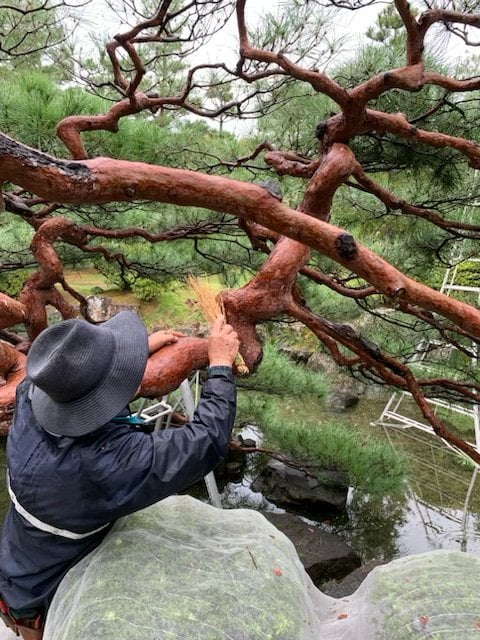
We encountered a gardener with over 40 years of experience tending to a majestic red pine. Our curiosity led us to engage him in conversation, interrupting his delicate work. He explained that they typically aim for a “fluffy, feminine” look for red pines, while black pines are given a “harder, masculine” finish. The gorgeous red pine he was carefully working on was over 100 years old. He was gently peeling its bark to enhance the vibrant red colour and smooth texture. “I’ve cared for this tree for 10 years,” he mentioned with a quiet pride. “You’re an expert, then,” I replied, to which he laughed and said, “Ten years is nothing in our job.”
A Garden Preserved Through Owner’s Dedication
When we praised his efforts, the gardener responded humbly. “It is not me who should be praised, but the owner of this garden. He is committed to preserving its original beauty. He has invested significantly to maintain it, even when many who inherit such gardens do not continue the same level of care or cut costs.” We nodded in agreement, having witnessed this unfortunate trend ourselves in other gardens. His words highlighted the owner’s dedication, and the gardener added, “This commitment deserves recognition for generations to come.”
This special place has been visited by the former Emperor and Empress. In Japan, this is the highest seal of approval. It underscores the garden’s significance and esteem among the country’s most beautiful gardens. It’s also a ryokan (a traditional Japanese inn), where guests can stay overnight. You don’t have to stay. You can simply pay admission to visit. And if you like, enjoy a meal, or take a relaxing dip in the adjacent restaurant or hot spring. Whether you choose to spend the night or just a few hours, this garden offers an unforgettable experience of Japanese beauty and craftsmanship.
Tools Developed for Japanese Pine Pruning
For tasks like trimming pine buds, Japanese gardeners use precise tools like the Kuroco Pointy Tip Single Edged Scissors or Compact Secateurs “Dainty” Ken-Katabami. These tools are slim and fit easily in the palm. This allows gardeners to switch smoothly between using their fingers to remove buds and the scissors to prune branches. The compact design means they don’t need to put the scissors back in the holster each time. This makes the process more efficient and fluid.
#blackpine#redpine#drygarden#japanesegarden#yamaguchi#landscapedesign#bucketlist#gardentourism#hotsprings#culturalheritage#gardenofinstagram